
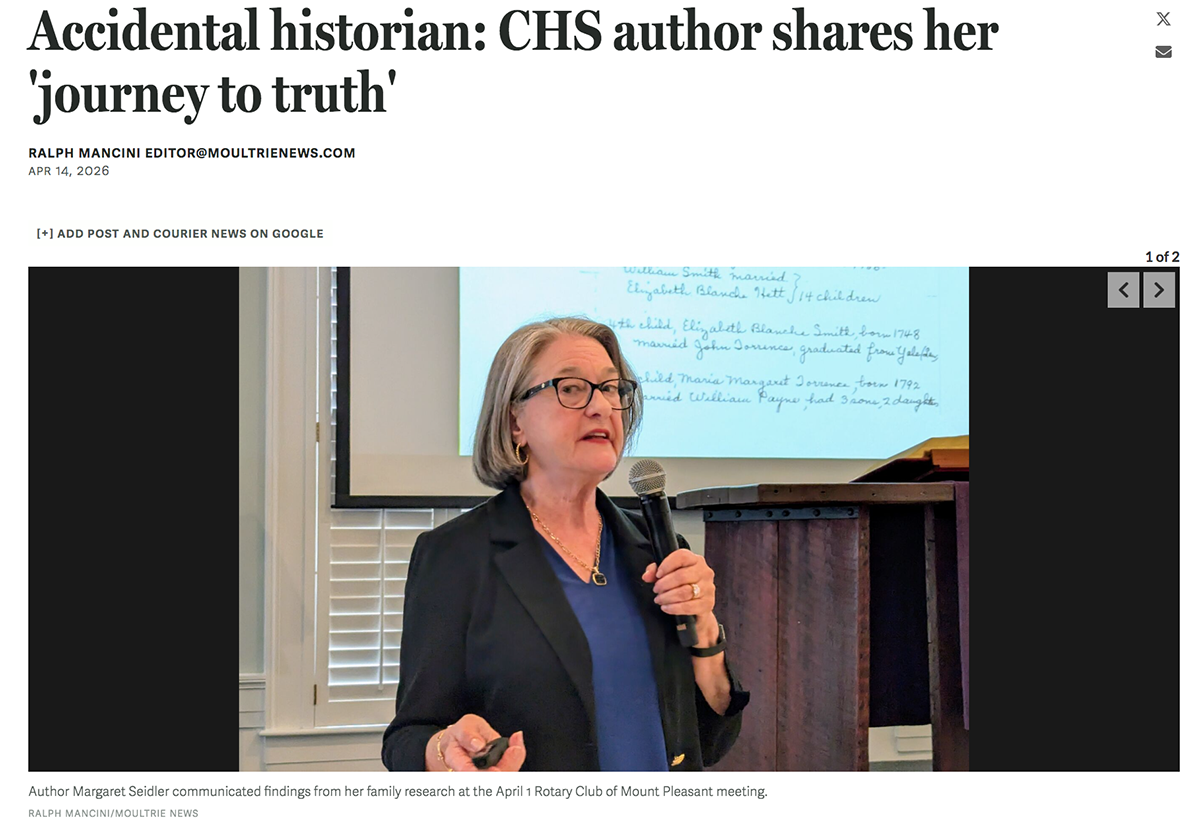
After 65 years of being told she came from good German stock, a Charleston author’s revelatory research of her genealogy dispelled much of what had been passed down through different generations of her own family.
The year was 2018 when Margaret Seidler took up a friend’s suggestion to learn about her ancestors via DNA testing offered through 23 & Me. In the process of analyzing the information, Seidler came across a message left to her from a fifth African-American cousin, Pearlstein Simmons, she previously had no knowledge of (Pearlstein is one of several Black relatives who currently reside in St. Augustine).
The disclosure of documented history that followed was the subject of Seidler’s subsequent book titled “Payne-ful Business: Charleston’s Journey to Truth,” which she answered questions on at the April 1 Rotary Club of Mount Pleasant meeting.
Prior to learning about her family’s background from the 1700s on, Seidler relied on a family “bible” kept by her grandmother Marie Gruber Dandridge, who died at 100 years old in 1983.
“This has just totally been something that I chose to do, and it’s probably the most important work I’ve done in my entire almost 74 years,” said Seidler.
One data piece the University of South Carolina graduate was able to use from her grandmother’s notes is a link to Yale University. In particular, she came across a judge, William Smith, who served on the British Privy Council, who graduated from Yale. Her continued research of her grandmother’s notes led her to Smith’s fourth child Elizabeth, born in 1748, who later married John Torrans. None of these people had a shred of German in them, she noted. In fact, Torrans came to Charleston from Ireland in 1758.
“He married well, he married this judge’s daughter and came to Charleston to get rich because Charleston was one of the richest cities in the colonies,” continued the Rotary guest speaker.
Torrans would end up being a partner in the Torans, Greg and Poaug law firm, which was responsible for bringing several Huguenots to the Holy City, along with hundreds of slaves from Africa.
The sudden realization that three generations of her forefathers were actual slave traders was rather daunting, but it didn’t stop the former conflict resolution specialist from digging into her family history.
The fearless researcher stumbled upon a Torrans slave trade ad, which helped her in learning about a distillery plantation owned by the Irish-American consisting of 795 acres along Shem Creek, then known as Parris’ Creek.
An old transcription reported Torrans telling his brother that they would need to mortgage slaves in order to purchase a ship that would be used to makes trips to Europe.
Torrans’ son-in-law, William Payne, traveled from his native Ireland to Charleston in 1786 at the age of 20. Payne opened a small retail shop on Elliott Street. He remained there until he went bankrupt in 1803, and decided to pursue a career in domestic slave trading. This practice didn’t involve shipping in people from Africa, but rather dealing off folks who had already been raising families here for generations.
By searching through an online database, Seidler determined that 9,595 slaves were sold by her great-grandfathers on Broad Street, from 1803 to 1833. A 1998 book titled “Slaves in the Family” by Edward Ball was especially instrumental in her research.
“We didn’t really talk about slavery in Charleston until that book came out. It was just history, it was just the past. It didn’t really impact us.”
Seidler’s database and 1,100 ads in her collection revealed that people could be sold or rented. In one of Payne’s biggest sales, he moved 367 individuals over two days for a little over $8 million.
“They said you could rent people [and] that you would have people benefitting from the system of slavery, so they’d be less likely to be against it,” she reasoned.
In January 2021, Seidler and her husband, Bob, installed a marker at 34 Broad St. — a property her family owned until 1859 — to educate the public that people were “literally” sold in those buildings, she explained.
“That is something that in modern times had never been revealed. So, even though I’m an accidental historian, I actually uncovered something new, or recovered something new.”
To learn more of Seidler’s finding, purchase “Payne-ful Business: Charleston’s Journey to Truth, available on Amazon and local bookstores.
Moultrie News
“Accidental historian: CHS author shares her ‘journey to truth'”
Ralph Mancini; Apr 14, 2026